B2B Email Marketing in 2026: How to Increase Conversions
B2B email marketing remains one of the most effective channels for building relationships, generating leads, and supporting sales. While reach on social media is increasingly influenced by algorithms and ever-changing platform rules, email marketing gives businesses direct access to both potential and existing customers, enabling them to build long-term relationships. Success, however, doesn't happen automatically. Modern B2B email marketing requires a well-defined strategy, effective audience segmentation, automated nurture sequences (designed to build trust), and continuous performance analysis.
What Is B2B Email Marketing?
B2B email marketing refers to communication between businesses via email with the goal of:
- generating new business opportunities,
- building trust and long-term relationships,
- educating potential customers,
- supporting the sales process,
- increasing customer retention.
Unlike B2C communication, B2B buying cycles are significantly longer, and purchasing decisions often involve multiple stakeholders. That's why communication must be highly personalized, relevant, and focused on building long-term relationships.
Cold Outreach vs. Lead Nurturing
Many companies associate B2B email marketing solely with outbound prospecting emails. In reality, there are two primary approaches.
Cold Outreach
Cold outreach involves contacting prospects who have not yet expressed interest in your company.
The objectives are to:
- start a conversation,
- identify a business need,
- schedule a meeting or product demo.
A successful cold email:
- addresses a specific pain point,
- is concise,
- clearly communicates value,
- includes a simple call to action.
Lead Nurturing
Lead nurturing begins once a potential customer shows interest by:
- downloading an e-book,
- registering for a webinar,
- completing a form,
- visiting key pages on your website.
At this stage, the goal is to educate prospects and guide them through the buying journey.
Lead nurturing forms the foundation of a successful B2B email marketing strategy.
OpiTip: One of the most common mistakes in B2B email marketing is sending the same message to your entire database. Before launching any campaign, define your Ideal Customer Profile (ICP) and segment your contacts based on industry, company size, job role, or stage in the buying journey.
Modern CRM systems then allow you to personalize subject lines, email content, and calls to action for each segment. The result is more relevant campaigns, higher open and click-through rates, and ultimately more qualified business opportunities.
A simple rule to remember: The better you understand your audience, the greater the chance your email will lead to a conversion.

Nurture Sequences: From Awareness to Purchase
One of the greatest advantages of B2B email marketing is the ability to automate lead nurturing.
Awareness Stage
At this stage, the customer becomes aware of a problem.
Content:
blog articles,
checklists,
reports,
educational videos.
Example Sequence
Email 1:
Introduce the problem.
Email 2:
Industry statistics and trends.
Email 3:
Practical recommendations.
Consideration Stage
At this stage, the prospect is actively searching for a solution.
Content:
case studies,
solution comparisons,
webinars,
expert analyses.
Example Sequence
Email 1:
Customer case study.
Email 2:
The most common mistakes when choosing a solution.
Email 3:
Comparison of available alternatives.
Decision Stage
The potential customer is deciding between different vendors.
Content:
product demo,
consultation,
ROI calculator,
customer testimonials.
Example Sequence
Email 1:
Showcase customer success stories.
Email 2:
Invitation to a product demo.
Email 3:
Limited-time offer.
Well-designed nurture sequences like these can significantly increase the number of qualified sales opportunities.
Re-engagement Campaigns
Every contact database loses engagement over time.
That's why it's important to regularly reconnect with inactive contacts.
Re-engagement sequences may include:
industry trends,
exclusive content,
special offers,
customer satisfaction surveys.
If a contact remains unresponsive after several attempts, it is best to remove them from your database.
A clean database improves both email deliverability and sender reputation.
B2B Newsletters as a Tool for Building Authority
Many companies use B2B newsletters solely to promote their products or services. However, successful newsletters deliver genuine value.
OpiTip
The best-performing B2B newsletters aren't those that constantly promote products and services. Instead, they provide valuable insights that help subscribers make better decisions and stay informed about developments in their industry.
Regularly include market updates, industry trend analyses, expert commentary, case studies, and recommended articles in your newsletter. If your content consistently provides value, subscribers will look forward to your emails, and your brand will stay top of mind when they're ready to buy.
In B2B email marketing, trust is built through value, not through the frequency of sales messages.
Email Marketing for B2B Lead Generation
Email marketing delivers the best results when combined with:
SEO,
LinkedIn marketing,
PPC advertising,
content marketing,
webinars.
A typical workflow:
A visitor lands on your website.
They download gated content in exchange for their email address.
An automated nurture sequence begins.
Based on their engagement and behavior, the company determines whether they are a qualified prospect.
The sales team takes over the conversation.
This process creates a predictable pipeline of new business opportunities.
Email Signature Marketing: An Untapped Opportunity
Every employee sends dozens of emails every day. That's why email signatures represent an often-overlooked marketing channel.
OpiTip
Turn every outgoing email into a marketing opportunity. Add a banner promoting your product demo, webinar, e-book, or case study to your email signature. Even a subtle call to action can generate new leads over time without increasing your advertising budget.
CRM Integration: The Foundation of Success
Modern B2B email marketing services should be fully integrated with your CRM system.
Benefits include:
automated lead scoring,
activity tracking,
more accurate audience segmentation,
improved ROI reporting.
The most commonly used platforms include:
HubSpot,
Salesforce,
Microsoft Dynamics,
Pipedrive,
ActiveCampaign.
Connecting your CRM with your email marketing platform enables highly personalized campaigns in real time.
B2B Email Marketing Benchmarks by Industry
Performance varies significantly across industries.
Average benchmarks:
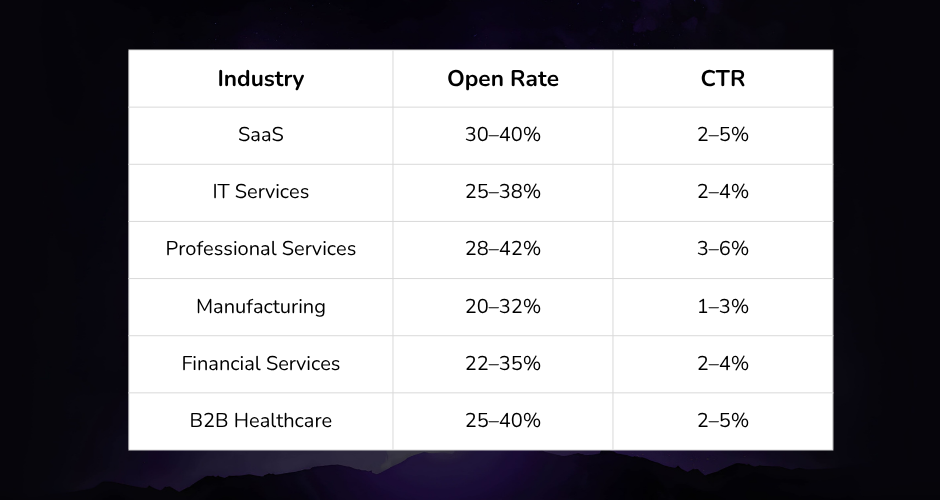
When evaluating your campaigns, it's even more important to track:
- the number of qualified leads,
- the number of sales meetings,
- pipeline value,
- return on investment (ROI).
OpiTip: Don't measure the success of your email marketing solely by open rates. What's far more important is how many qualified leads, sales meetings, or new customers your campaigns actually generate. These are the metrics that truly reflect email marketing's contribution to business growth.
Conclusion
B2B email marketing remains one of the most powerful tools for generating leads and building long-term business relationships. Companies that combine effective audience segmentation, automated nurture sequences, CRM integration, and relevant content consistently achieve higher sales performance.
If you want email marketing to become a predictable source of new business opportunities, simply sending newsletters isn't enough. You need a well-defined strategy, the right technology stack, and content that engages customers at every stage of the buying journey.
At Opinest, we help businesses design and implement email marketing strategies that deliver measurable business results, from building high-quality contact databases and creating automated campaigns to audience segmentation, CRM integration, and ongoing performance optimization.